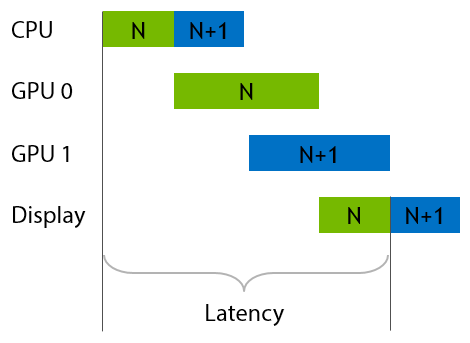
Before we dig into VR SLI, let's first explain how “normal”, non-VR SLI works. For years, we’ve had alternate-frame SLI, in which the GPUs trade off frames. In the case of two GPUs,
one renders the even frames and the other the odd frames. The GPU start times are staggered half a frame apart to try to maintain regular frame delivery to the display.
This works well to
increase framerate relative to a single-GPU system, but it
doesn’t really help with latency. So this isn’t the best model for VR.
A better way to use two GPUs for VR rendering is to
split the work of drawing a single frame across them—namely, by
rendering each eye on one GPU. This has the nice property that it
improves both framerate and latency relative to a single-GPU system.

 sli kombollakin pitää noilla resoilla/hz pitää palikka ukkoja kattella.